Biomod/2014/Sendai/Design
<html> <head> <style type="text/css">
html{
      background-color: #5b2d01;
      height: 100%;
} body{
      background-color: #f5e4b4;
      font-size: 1.4em;
      font-size: 125%;
      font-family:Arial,'Lucida Grande';
      height: 100%;
}
figure{
margin-bottom: 10px;
} figcaption{
font-size: 14px;
}
/* hiding wikiUI*/
.firstHeading {
display:none;
}
- content{
background-color: #f5e4b4;
background-image: linear-gradient(#f5e4b4,#eace7f);
border-style:none;
margin:0;
padding-top:0px;
padding-bottom:15px;
padding-right:0px;
padding-left:0px;
min-height:600px;
}
- globalWrapper{
font-size:100%;
}
- contentSub{
display:none;
}
- column-one{
display:none;
}
- footer{
display:none;
} /*----------*/
- header{
       height: 96px;
       width:1000px;
       margin:0 auto;
       margin-top: 10px;
       margin-bottom: 10px;
}
- left_header{
height: 96px; width: 96px;
float:left;
}
- homebutton {
       width: 96px;
       height: 96px;
       float: left;
}
- homebutton li{
display: inline;
}
- homebutton li a{
       float: left;
       height: 0px;
       width: 96px;
       padding-top: 96px;
       overflow-x: hidden;
       overflow-y: hidden;
       background-image: url(http://openwetware.org/images/0/02/Homebutton.png);
       background-repeat: no-repeat;
}
- homebutton #stamp a{ background-position: 0 -96px; }
- homebutton #stamp a:hover{ background-position: 0 0; }
- homebutton.home #stamp a{ background-position: 0 0; }
- globalnav {
height: 96px; width: 808px;
float:left;
}
- globalnav li{
display: inline; }
- globalnav li a{
float: left; height: 0pt; padding-top: 96px; overflow-x: hidden; overflow-y: hidden; background-image: url(http://openwetware.org/images/e/e8/Uiparts_navigation-01.jpg); background-repeat: no-repeat; }
- globalnav #gn-home a{ width: 55px; }
- globalnav #gn-intro a{ width: 122px; }
- globalnav #gn-design a{ width: 84px; }
- globalnav #gn-simu a{ width: 118px; }
- globalnav #gn-xp a{ width: 114px; }
- globalnav #gn-protocol a{ width: 92px; }
- globalnav #gn-dis a{ width: 112px; }
- globalnav #gn-team a{ width: 78px; }
- globalnav #gn-end a{ width: 71px; }
- globalnav #gn-home a { background-position: 0 0; }
- globalnav #gn-intro a { background-position: -55px 0; }
- globalnav #gn-design a { background-position: -177px 0; }
- globalnav #gn-simu a { background-position: -261px 0; }
- globalnav #gn-xp a { background-position: -379px 0; }
- globalnav #gn-protocol a { background-position: -493px 0; }
- globalnav #gn-dis a { background-position: -585px 0; }
- globalnav #gn-team a { background-position: -697px 0; }
- globalnav #gn-end a { background-position: -775px 0; }
- globalnav #gn-home a:hover { background-position: 0 -96px; }
- globalnav #gn-intro a:hover { background-position: -55px -96px; }
- globalnav #gn-design a:hover { background-position: -177px -96px; }
- globalnav #gn-simu a:hover { background-position: -261px -96px; }
- globalnav #gn-xp a:hover { background-position: -379px -96px; }
- globalnav #gn-protocol a:hover { background-position: -493px -96px; }
- globalnav #gn-dis a:hover { background-position: -585px -96px; }
- globalnav #gn-team a:hover { background-position: -697px -96px; }
- globalnav #gn-home a:active { background-position: 0 -192px; }
- globalnav #gn-intro a:active { background-position: -55px -192px; }
- globalnav #gn-design a:active { background-position: -177px -192px; }
- globalnav #gn-simu a:active { background-position: -261px -192px; }
- globalnav #gn-xp a:active { background-position: -379px -192px; }
- globalnav #gn-protocol a:active { background-position: -493px -192px; }
- globalnav #gn-dis a:active { background-position: -585px -192px; }
- globalnav #gn-team a:active { background-position: -697px -192px; }
- globalnav.home #gn-home a { background-position: 0 -288px; }
- globalnav.intro #gn-intro a { background-position: -55px -288px; }
- globalnav.design #gn-design a { background-position: -177px -288px; }
- globalnav.simu #gn-simu a { background-position: -261px -288px; }
- globalnav.xp #gn-xp a { background-position: -379px -288px; }
- globalnav.protocol #gn-protocol a { background-position: -493px -288px; }
- globalnav.dis #gn-dis a { background-position: -585px -288px; }
- globalnav.team #gn-team a { background-position: -697px -288px; }
- wikiwrapper{
       width: 980px;
       background-color: #fffcf5;
}
- mainvisual{
       width: 980px;
       margin-left: auto;
       margin-right: auto;
       text-align: center;
}
- main{
       width: 980px;
       min-height: 600px;
       background-color: #fffcf5;
       padding-right: 15px;
       padding-left: 15px;
       padding-bottom: 150px;
       margin-right: auto;
margin-left: auto;
       text-align: justify;
       font-size: 110%;
}
p{
text-indent:1em;
}
/*テーブルの色づけ*/
table.table tr:nth-child(odd) {
 /* 奇数行の背景色を設定します。 */
 background-color: #ecf6fb;
} table.table tr:nth-child(even) {
 /* 偶数行の背景色を設定します。 */
 background-color: #ffffff;
}
.overline{
       text-decolation: overline;
      }
/*simulationページの段組みコンテナ*/
- container {
      width: 100%;
      height: auto;
      height: 100%;
      min-height: 100%;
}
div.blockleft{
      float: left;
      width: 625px;
      height: 475px;
} div.blockright{
      float:right;
      width: 355px;
      height: 490px;
div.blockleft2{
      float: left;
      width: 450px;
      height: 475px;
} div.blockright2{
      float:right;
      width: 450px;
      height: 475px;
} div.block{
      width:980px;
      height: 475px;
      margin-bottom: 20px;
}
p.textbox{
padding:20px;
}
div.blockright span{
vertical-align: middle;
}
- new_footer{
margin-top:30px;
padding-top:15px; width:100%; height:100px; background-color:#5b2d01; color:#fff;
       font-size: 125%;
       position: absolute;
       bottom: 0;
       display: inline;
}
.lefttext{
       height:auto;
       width:30%;
       padding-left:20%;
       float:left;
}
.rightimg{
       height:auto;
       width:30%;
       padding-left:20%;
}
</style> </head> </html> <html> <head> <title></title>
<style type="text/css"> .overline {
text-decoration: overline;
} </style> </head>
<body>
Design
To complete our goal, it is necessary to develop a system that releases output liposome in order. The liposome encapsulates taste substances and is immobilized on substrate. The order of output is coded on input DNA. Following two different approaches are proposed.
<a href="#approach1">1st Approach</a> /
<a href="#approach2">2nd Approach</a>
1st Approach: Enzyme system
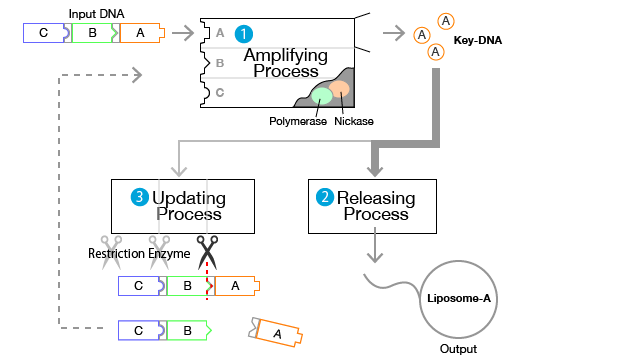
This system uses DNA as an input and following reaction are driven by enzymes such as polymerase, nickase, and restriction enzyme. These enzymes can be regarded as hardware while DNA serves as software. In this system, there are three processes shown in Fig.1. Before the addition of input DNA, some sets of DNA molecule (Templates, Gates) and enzymes are mixed in advance.
1. Amplifying process: DNA polymerase amplifies key-DNA for next 2nd and 3rd process.
2. Releasing process: Key-DNA releases the liposome that encapsulates taste substances.
3. Updating process: Restriction enzyme updates the input-DNA sequence to repeat next circle.
Following section explains the enzyme system when the input DNA encodes “ABC”.
<img src="http://openwetware.org/images/9/9e/Fde1a0-01.png">
Fig.1 Schematic explanation of Enzyme system
1. Amplifying process
In this process, DNA polymerase creates key-DNA (in this case A1) for next processes. Then, key-DNA A1 is amplified by polymerase, nickase, and templates when input is added.(Fig.2) The sequence of template-A is 5’-A1 A0-3’. The sequence A0 is complementary to A. Furthermore, Input DNA that encodes “ABC” has a sequence of 5’-C0 x B0 x A0-3’.
The details of this process is shown as follows.
When input DNA is added, the sequences A0, B0, and C0 in the templates hybridizes to sequences A0, B0, and C0 in the inputs respectively (we name the hybridized structure “Complex”)(①). Then, polymerase extends the input from 3’ end synthesizing new sequence A1 that is complementary to the template DNA(②). After that, the nickase cleaves sequence between A0 and A1 by recognizing the sequence in A0(③). Then, polymerase works at the gap created by the nickase thereby DNA displaces the domain A(④). Repeating ③,④, the sequence A1 is amplified.
This amplified sequence will become an input of following process 2nd and 3rd.
<img src="http://openwetware.org/images/c/c9/Figure-01.png">
Fig.2 Schematic explanation of the amplifying process
2. Releasing process
This process releases the liposome-A when it accepts the A1 sequence DNA from amplifying process.(Fig.3) The liposome is immobilized on substrate in advance. To immobilize that, cholesterol-modified DNA (output-A) and thiol-modified DNA can be used. Thiol-modified DNA can be fixed on gold plate. When output-A attached on liposome hybridizes to thiol-modified DNA, liposome is immobilized on substrate.
The details of this process is shown as follows.
After the amplifying process, A1 sequence hybridizes to thiol-modified DNA on substrate(⑤). Polymerase synthesizes new DNA from the 3’-end of A1, separating existing hybridization(⑥). Eventually, liposome-A is released with output-A from the A1 sequence.
<img src="http://openwetware.org/images/a/a2/Figure2_fusen-04.png">
Fig.3 Schematic explanation of the releasing process
3. Updating process
In this process, the code “A” on the complex is updated to next code (in this case “B”) by gate-A, polymerase, and restriction enzyme.(Fig.4) After the acceptation of key-DNA A1 from amplifying process, gate-A creates signal-A whose sequence is 5’-A0 x α-3’.
The domain “x” is recognition site for restriction enzyme.
Signal-A forms the recognition site for restriction enzyme when it hybridizes to the complex. After that, restriction enzyme cleaves the complex. This cleaving means that the code on input updated.
The details of this process is shown as follows.
After A1 hybridize to Gate-A(⑦), polymerase extends A1 and displace a signal DNA(⑧). When the signal DNA hybridizes to input complex, a recognition site for the restriction enzyme is formed(⑨). Due to the recognition site, restriction enzyme cleaves the complex, forming a next complex for the repetition(⑩).
The three processes are repeated with the code changed. Regardless of the numbers and kinds of domains, the orders of outputs only depend on encoded information in the input.
<img src="http://openwetware.org/images/7/7f/Figure3-01.png">
Fig.4 Schematic explanation of the updating process
2nd Approach; Enzyme-free System
<img src="http://openwetware.org/images/8/82/Enzyme-free.png">
Fig.5 #
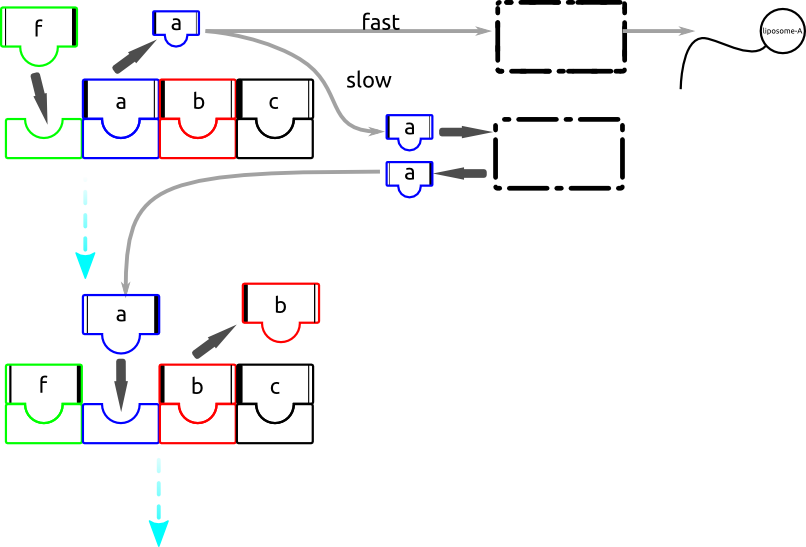
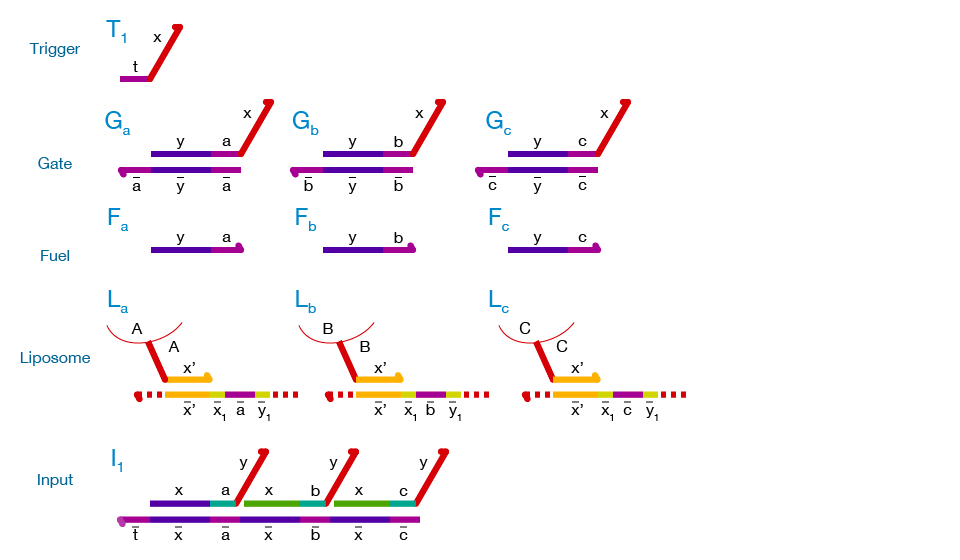
This approach is inspired by seesaw gate (Lulu Qian et.al, 2011). Our goal is to get different output signals in order of input signals. In this system , we should arrange a input , a trigger ,fuels, the double strand DNA bonding with liposome.
<img src="http://openwetware.org/images/7/70/Figure_EnzymeFree2-02.png">
Fig.6 #
(用意するもの) fuel,gate、Liposomeが結合した二本鎖DNA (Fa,b,c Ga,b,c La,b,c) input(I1),trigger(T1)それぞれ一種類
Reactions as follows :
1.
Input-DNA sequence are dissolved in the solution including trigger , fuels , gates , and the double strand DNA bonding with liposome. Then, trigger combines with input and the single strand DNA (DNA1)which makes input are released.
2.
DNA1 combines with the double strand DNA bonding with liposome . In this reaction , the single strand DNA bonding with liposome are released due to the difference in length of DNA sequence which makes the double strand DNA. This reaction causes earlier so that toehold is longer than that of gate.
3.
Other DNA1 combine with gate(Ga). the single strand DNA (DNA2)which makes gate(Ga) are released so that the length of the double strand is difference. In addition , DNA1 combines with gate.
4.
DNA1 is released again so that DNA3 react with fuel(Fa) , due to the difference in length of DNA.
5.
When we perform process3 and 4 repeatedly , the number of DNA2 is increasing. DNA2 is the key of next process.
<img src="http://openwetware.org/images/2/24/Figure_EnzymeFree2-03.png">
Fig.7 #
6.
DNA2 combines with input as trigger , so the reaction said above caused.In this reaction , DNA is released as DNA2 in the reaction said above .
<img src="http://openwetware.org/images/6/6f/Figure_EnzymeFree2-04.png">
Fig.8 #
7.
DNA4 combines with input as trigger , so the reaction said above caused.
We can get output signals in order by using this reaction.
</body> </html>