Kim:Research: Difference between revisions
No edit summary |
No edit summary |
||
| Line 18: | Line 18: | ||
<div style="padding: 10px; text-align: left; float: left; border: 1px solid #000000;"> | <div style="padding: 10px; text-align: left; float: left; border: 1px solid #000000;"> | ||
<div style="padding: 1px; color: # | <div style="padding: 1px; color: #ffffff; background-color: #ffffff; width: 970px"> | ||
<font face="trebuchet ms" size=4 style="color:#000">'''Research Overview:</font> <br> </div> | <font face="trebuchet ms" size=4 style="color:#000">'''Research Overview:</font> <br> </div> | ||
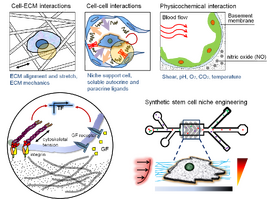
Our research focuses on investigating how the engineered microenvironments direct cell function and tissue regeneration. In particular, we are exploring extracellular matrix (topology, rigidity, dimensionality, etc) regulation of cell fate and function in developmental, physiological and pathological process. Several specific thrusts of the current research program include: microengineered platforms for cell-matrix mechanobiology, mechanical regulation of cancer cell invasion and collective cell migration, microscale cardiovascular tissue engineering, and BioMEMS for stem/progenitor cell niche engineering. Here is a summary of our current research projects. | Our research focuses on investigating how the engineered microenvironments direct cell function and tissue regeneration. In particular, we are exploring extracellular matrix (topology, rigidity, dimensionality, etc) regulation of cell fate and function in developmental, physiological and pathological process. Several specific thrusts of the current research program include: microengineered platforms for cell-matrix mechanobiology, mechanical regulation of cancer cell invasion and collective cell migration, microscale cardiovascular tissue engineering, and BioMEMS for stem/progenitor cell niche engineering. Here is a summary of our current research projects. <br> | ||
{| cellspacing="3" | {| cellspacing="3" | ||
|- valign="top" | |- valign="top" | ||
<div style=" | |width=710px class="MainPageBG" style="background-color: #ffffff"| | ||
<div style="padding: 1px; color: #ffffff; background-color: #ffffff; width: 710px"> | |||
<font face="trebuchet ms" size=4 style="color:#000">'''Technological:</font> <font face="trebuchet ms" size=3 style="color:#00688B">Micro- and Nanoscale engineering of biomimetic in vitro cell culture models and functional tissue scaffolds </font> <br> </div> | |||
Our current research focuses on engineering combinatorial cellular microenvironment through use of variable nano-patterns, and soluble and matrix-bound cell guidance cues in a single experiment, which better mimics the in vivo microenvironment under physiological conditions. For example, we are developing a microfluidics-based on chip assay integrated with complex nanoscale topographic features to enable the analysis of concerted cell responses to composite gradients of precisely generated and aligned | <div style="clear: right; text-align: left; float: left; width: 710px;"> | ||
Our current research focuses on engineering combinatorial cellular microenvironment through use of variable nano-patterns, and soluble and matrix-bound cell guidance cues in a single experiment, which better mimics the in vivo microenvironment under physiological conditions. For example, we are developing a microfluidics-based on chip assay integrated with complex nanoscale topographic features to enable the analysis of concerted cell responses to composite gradients of precisely generated and aligned surface-bound ECM molecules and diffusible guidance cues or topographic guidance cues. Using these tools, we strive to systematically characterize live cells to wide spectra of dynamically changing combination of mechanical and chemical stimuli (e.g. ECM proteins, topographic, growth factors and signal transduction pathway inhibitors). The proposed measurements are highly resolved in time and space, using a variety of live cell probes and highly defined extracellular conditions. In collaboration with other nanofabrication groups, we are developing nanotopography-integrated cell culture systems and biomaterial tissue scaffolds using UV-assisted capillary force lithography and/or nanoimprinting techniques. For high-throughput analysis, we are also working to combine a large area nanopatterned substrate with a traditional multi-well tissue culture plate. We aim to use these tools to gain new mechanistic insights into cell signaling and function, to design new therapies or diagnostic tests for cancer progression and cardiovascular diseases, and to establish organizing principles for development of precisely defined scaffolds for advanced tissue engineering applications. | |||
<br> | <br> | ||
</div> | </div> | ||
|width=270px class="MainPageBG" style="background-color: #ffffff"| | |||
[[Image:Technological.tif|270x270px]] | |||
|} | |} | ||
Revision as of 15:57, 2 November 2010

|
Research Overview:
Our research focuses on investigating how the engineered microenvironments direct cell function and tissue regeneration. In particular, we are exploring extracellular matrix (topology, rigidity, dimensionality, etc) regulation of cell fate and function in developmental, physiological and pathological process. Several specific thrusts of the current research program include: microengineered platforms for cell-matrix mechanobiology, mechanical regulation of cancer cell invasion and collective cell migration, microscale cardiovascular tissue engineering, and BioMEMS for stem/progenitor cell niche engineering. Here is a summary of our current research projects.
Fundamental: Systems mechanobiology of cell-matrix and cell-cell interactions in collective and directed cell migration
Mechanotransduction - from how cells sense mechanical forces in different tissues to how these mechanical forces are transduced into biochemical signals - is an essential biological process in development, normal physiology and disease. In this exciting area, we are particularly interested in investigate the role of mechano-biological processes associated with cell-cell and cell-matrix 
Translational: Microenvironmental stem cell niche engineering and cardiovascular tissue engineering
With advances in nanofabrication and biomaterials, scaffolding materials can be designed to integrate biomimetic structural and mechanical cues present in the in vivo ECM environment. Based on ultrastructural analyses of the native heart tissue, we are developing a bio-inspired model cardiac tissue to better understand cardiac tissue structure-function relationships, and to seek applications in stem cell-based therapies for cardiac tissue repair and regeneration. The ultimate goal of this project is to develop nanopatterned functional cardiac patches for treating the demaged heart tissue 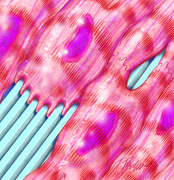
|