Biomod/2012/Titech/Nano-Jugglers/Methods
<html> <head> <style type="text/css"> /* ====================
主に全体に関わるCSS
==================== */ body.mediawiki {
font-size: 14px;
background-image:url(http://openwetware.org/images/2/2d/TNJback.png); background-repeat: repeat; font-family: Calibri, Verdana, helvetica, sans-serif; }
               h1 {
                       padding: 0px 20px 5px 20px;
                       font-size: 34px;
                       line-height: 40px;
                       font-weight: bold;
               }
               h2 {
                       padding: 20px 20px 5px 20px;
                       font-size: 25px;
                       color: #000000;
                       text-decoration: none;
                       font-weight: bold;
              }
               h2 a {
                       color: #eb8300;
               }
               h3 {
                       padding: 20px 20px 5px 20px;
                       font-size: 20px;
                       color: #000;
                       font-decoration: none;
                       font-weight: bold;
               }
               h1.firstHeading {
display: none;
}
p { text-align: justify; } a:link { color: #00a5ea; text-decoration: none } a:visited { color:#00a5ea; text-decoration: none } a:hover {
color: #eb8300;
text-decoration: none } a:active { color:#f29400; text-decoration: none } #content{ margin: 0px 0 0px 0; align: center; padding: 12px 12px 12px 12px; width: 946px; background-color: #ffff; border: 0; } #bodyContent{ width: 970px; margin: 150px auto 0 auto; align: center; background-color: #ffffff; } #globalWrapper{ margin: 20px 0 0 0; width:994px; background-color: #ffffff; margin-left: auto; margin-right: auto } #biomodlink{ position:absolute;top:0px; width:970px;height:20px; background-color: #ffffff; margin:3px auto 3px auto }
/* ====================
  メニューの画像を変更できる部分
  ==================== */
#header {
                       margin: 0 auto 0 auto;
                       position:absolute;
                       top:28px; width:968px;height:189px;
background-color: #FFFFFF; background-repeat: no-repeat;
background-image: url(http://openwetware.org/images/7/74/Title-LOGO6.jpg);
} /* ====================
  以下、特殊なclassに適用される
  ==================== */
#navigation { position:absolute;
                       top:120px; width:970px; height:92px;
                       background-repeat: no-repeat;
color: #0000FF; }
/* ====================
  ここからプルダウン周辺のデザイン
  ==================== */
- menu * {
margin: 0; padding: 0; }
- menu {
position:absolute;
font-family: calibri, verdana, sans-serif;
font-color: #000000;
background-color: transparent; float:left; display: block; }
- menu ul {
position:relative;
float: left; text-align:center; list-style: none; }
- menu li {
background-color:yellow;
position:relative;
float:left;
width: 136px;
font-size: 23px;
font-weight: bold;
border:ridge 0px #FFFFFF; }
- menu li.ach {
background-color:yellow;
position:relative;
float:left;
width: 162px;
font-size: 23px;
font-weight: bold;
border:ridge 0px #FFFFFF; }
- menu li.sup {
background-color:yellow;
position:relative;
float:left;
width: 109px;
font-size: 17px;
font-weight: bold;
border:ridge 0px #FFFFFF; }
- menu li.none {
background-color:yellow;
position:relative;
float:left;
width: 152px;
font-size: 17px;
font-weight: bold;
border:ridge 0px #FFFFFF; }
- menu a {
color: #000000; display:block; text-decoration: none; }
- menu a:hover {
background-color:gold; }
- column-one { display:none; width:0px;}
.container{background-color: #ffffff; margin-top:0px} .OWWNBcpCurrentDateFilled {display: none;}
- footer{position: center; width: 994px}
@media screen {
body { background: #F5F5F5 0 0 no-repeat; /* changed default background */ }
} </style> </head> <BODY>
<<a href="http://openwetware.org/wiki/Biomod">BIOMOD</a>|<a href="http://openwetware.org/wiki/Biomod/2012">2012</a>|Titech Nano-Jugglers
</BODY> </html>
Experimental Methods
| <html><img src="http://openwetware.org/images/5/50/Goals.jpg" width="400px"></html> | <html><img src="http://openwetware.org/images/1/10/Goals.png" width="500px"></html> | |
We have set 3 goals, that is "Rail-free", "High-speed", and "Control". To achieve them, we confirmed"Construction of the body" , "Energy production for rail-free and high-speed movement", and "directional control of Biomolecular Rocket". | ||
0.Body
- Construction of the body of Biomolecular Rocket
- Rocket is consisted of 10μm beads, 0.15~0.40μm platinum particles, and DNA. By using DNA, platinum or catalase particles are conjugated to 10μm beads. Beads have been addressed by the deposition of gold and chromium, so DNA was able to conjugate to beads region-specific. In addition, we designed the photoresponsive DNA for allowing detachment of the engines from the Biomolecular rocket’s body upon the UV light irradiation in a region-specific manner.
- In this section, we introduce 5 methods that involved in construction of the body of Biomolecular Rocket.
| <HTML><A href=#Vapor_deposition_of_Au_and_Cr_on_the_polystyrene_body title="Vapor deposition"><IMG width="190px" src="http://openwetware.org/images/5/5c/Vapor_deposition_method.jpg"></A></HTML> | <HTML><A href=#DNA_Design title="DNA design"><IMG width="190px" src="http://openwetware.org/images/b/b2/DNA_design.jpg"></A></HTML> | <HTML><A href=#DNA_conjugation title="EDAC conjugation"><IMG width="190px" src="http://openwetware.org/images/a/a4/EDAC_conjugation_method.jpg"></A></HTML> | <HTML><A href=#DNA_conjugation title="SAM conjugation"><IMG width="190px" src="http://openwetware.org/images/2/2a/Sam_conjugation_method.jpg"></A></HTML> | <HTML><A href=#Catalyst_conjugation_by_DNA_hybridization title="Catalyst conjugation"><IMG width="190px" src="http://openwetware.org/images/1/19/Conjugation_catalyst.jpg"></HTML> |
Vapor deposition of Au and Cr on the polystyrene body
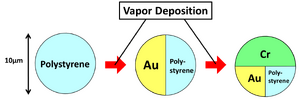
Vapor deposition is a method for forming a thin metal film on the surface of the substrate. In this project, Gold and Chromium were deposited on the polystyrene beads in order to conjugate specific DNA onto the determined location on the surface.

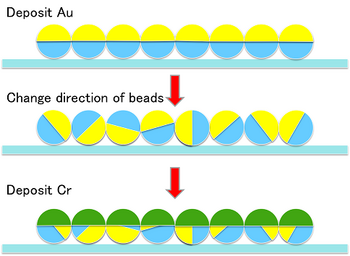
1st Deposition
First, we deposit gold on the polystyrene-bead in order to make gold hemisphered body.
2nd Deposition
Next, we change the direction of beads, and deposit chromium on the body. Then we pick up polystyrene-bead, which are deposited by quarter gold and half chromium. By chromium capping, this "head part" is prevented to conjyugate DNA strands, so platinum only mounted at the rear.

- After vapor deposition
- Through twice of physical vapor deposition,
- we conjugate thiol modified DNA onto gold part.
- we conjugate amino modified DNA onto polystyrene part.
- There are no DNA staple strands on chromium hemisphere.
- Therefore, platinum particles can't conjugate onto chromium hemisphere. As a result, our rocket starts to move toward chromium hemisphere heading.
>>see Result
DNA Design
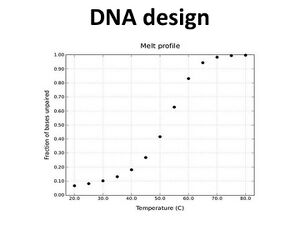
We designed five DNA strands. DNA strands relate to "amino modified DNA and polystyrene conjugation". One DNA strand is modified amino group to conjugate polystyrene-beads. The other one is a complementary strand, which is modified thiol group to conjugate platinum. Another DNA strand also is a complementary strand, which is modified FAM. On the other hand, Two DNA strands relate "SAM".One DNA strand includes azobenzene to photo-control. Another DNA is a complementary strand, which is modified thiol group to conjugate gold.

- We designed these DNA strands using NUPACK*1. And we selected orthonormal sequence, referring to a paper*2. When we designed DNA strands, we fixed the temperature at 25.0 °C and the Na+ concentration at 0.195M. And we selected DNA strands, which didn't form secondary structure.
- 1) NUPACK nucleic acid package. http://www.nupack.org/
- 2) Tetsuro Kitajima, Masahiro Takinoue, Ko-ichiroh Shohda, and Akira Suyama.
- Design of Code Words for DNA Computers and Nanostructures with Consideration of Hybridization Kinetics. LNCS 4848, 119-129 (2008)
>>see more Method
DNA conjugation
EDAC conjugation
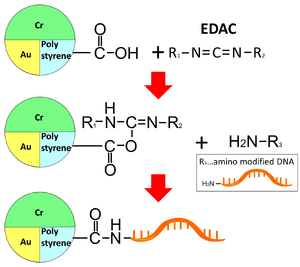
We bond polystyrene-beads with DNA using EDAC. EDAC is known as water-soluble carbodiimide (WSC) and is used as coupling agent to form amide bond. EDAC crosslinks nucleic acids to the surfaces, which have carboxy group. In this project, we used this method to conjugate amino modified DNA onto carboxylated polystyrene-beads. EDAC reacts with carboxylated polystyrene-beads to form active intermediate on the body. Then it reacts to amino modified DNA. The beads are coupled by nucleic acid. We divide the body into three parts including polystyrene surface, so it is possible to connect each DNA with position classification. By using this method, we can connect platinum to aircraft body part of polystyrene in a region-specific manner.

>>see Result
SAM conjugation
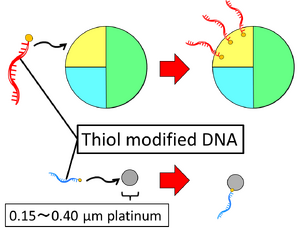
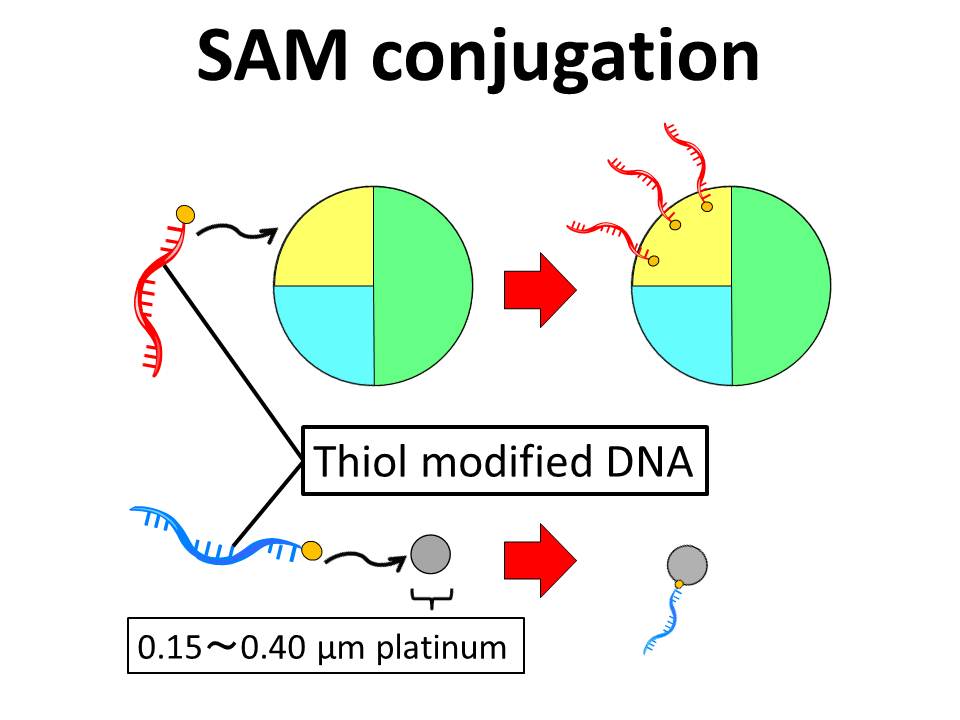
Self-assembled monolayers (SAM) of molecules are molecular assemblies formed spontaneously on substrate surfaces by chemical adsorption. This chemical reactions can be organized into large ordered domains and it is also possible to cover the substrate with functional end group that has some modification. In addition, few steps and experimental technique are required. SAMs are created by adsorption of head groups onto a substrate followed by a slow organization of tail groups.

- First, head groups are absorbed onto substrate over . In this phase, the surface of substrate is patterned with spots by dsorbeate molecules rather than beautiful membranes. Over the period of disordering form, the head groups assemble together on the substrate, while the tail groups assemble far from the substrate. Areas of concentrated molecules nucleate and grow until the surface of the substrate is covered in a single monolayer.
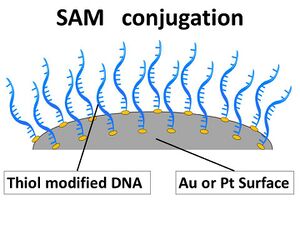
SAM conjugation onto gold
Thiolated compound and gold substrate are one of the most famous research of SAMs. Thiol modified DNA is conjugate to gold particles by this chemical reaction. Initially, substrate gold are cleaned by water or acid-base buffer in order to washout organic impurities. Gold particles are dissolved in 10mM phosphate buffer pH8, 10μM thiol modified DNA. Then in addition to NaCl, raise up to 0.7M salt concentration gradually over a day.Last,clean up again by proper buffer and dry. This reaction is also use with platinum In order to accomplish our project ,we need platinum-DNA and gold-DNA conjugation, so we use thiol modified DNA.

>>see Result
Catalyst conjugation by DNA hybridization
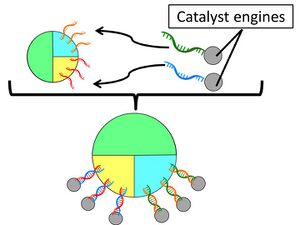
We conjugated the catalyst to our rocket body by DNA hybridization. Complementary strand DNA had adhered to the corresponding parts of the rocket body, so it enabled to conjugate catalyst engines in that we designed these DNA were thermodynamically stable when they hybridized.

- First, we prepared DNA-conjugated 10 μm sized polystyrene beads which were deposited 1/4 Au and 1/2 Cr. At the same time we prepared DNA-conjugated 0.15~0.40 μm sized platinum particles. Then, mixed these beads and platinum particles in 3×SSC buffer at 90℃, and cooled to room temperature slowly over time. Namely, annealing DNA by raising temperature at the first time, next make it easy to hybridize each other by downing to room temperature.
1.Rail-free
- Energy prodction for rail-free movement
- In order to realize rail-free movement, we looked at the function of catalyst. Platinum or catalase catalysts decompose H2O2 and emit H2O and O2 bubbles. Since the driving force created by divergence of bubbles, and rocket proceeds by dissociation of oxygen, rail does not require.
- In this section, we introduce 3 methods that involved in energy production for rail-free movement.
- <HTML><A href=#DNA_hybridization_in_solution_of_H2O2 title=DNA hybrudization><IMG width="190px" src="http://openwetware.org/images/f/f1/DNA_hybrudization.jpg"></A></HTML><HTML><A href=#Observation_of_platinum_hemisphere_behavior_in_solution_of_H2O2 title="Platinum hemisphere"><IMG width="190px" src="http://openwetware.org/images/4/4c/Platinum_hemisphere.jpg"></A></HTML><HTML><A href=#Energy_production_by_using_catalase title="Catalase"><IMG width="190px" src="http://openwetware.org/images/5/5a/Catalase_image.jpg"></A></HTML>
DNA hybridization in solution of H2O2

H2O2 has strong corrosion. There was a risk that DNA strand is denatured by H2O2. So, we had to ensure that the hybridization of DNA is not suffer from H2O2. We guess that if DNA had been destroyed, then molecular mass would decrease in that DNA can't hybridize. Measure the relative magnitude of the molecular weight by electrophoresis, we are able to examaine whether DNA can hybridize or not.
This time, we have to examine the state of the DNA in the time we need to steer rocket, set the time to soak and concentration of H2O2. We used PAGE electrophoresis to ascertain the stability of DNA duplex in thin H₂O₂ solution 1%~5%. PAGE electrophoresis shows the difference of molecular weight that comes from denaturetion or hybridization in the form of bands.

>>see Result
Observation of platinum hemisphere behavior in solution of H2O2
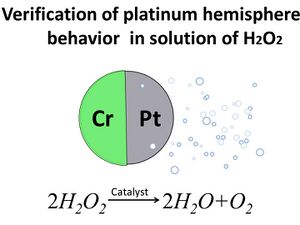
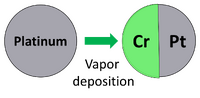
The driving force of Biomolecular Rocket is catalytic engine of platinum. This catalytic engine become more powerful, increasing the surface of platinum. Biomolecular Rocket has numerous platinum particles to increase the surface of platinum. In this experiment, we deposit chromium to 1µm beads which are covered platinum and we make half platinum beads. In addition, we observe a behavior of the beads in diluted H2O2 solution. From this experiment, we are able to investigate whether Surface area of platinum is related to the speed.


Energy production by using catalase
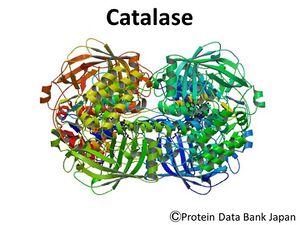
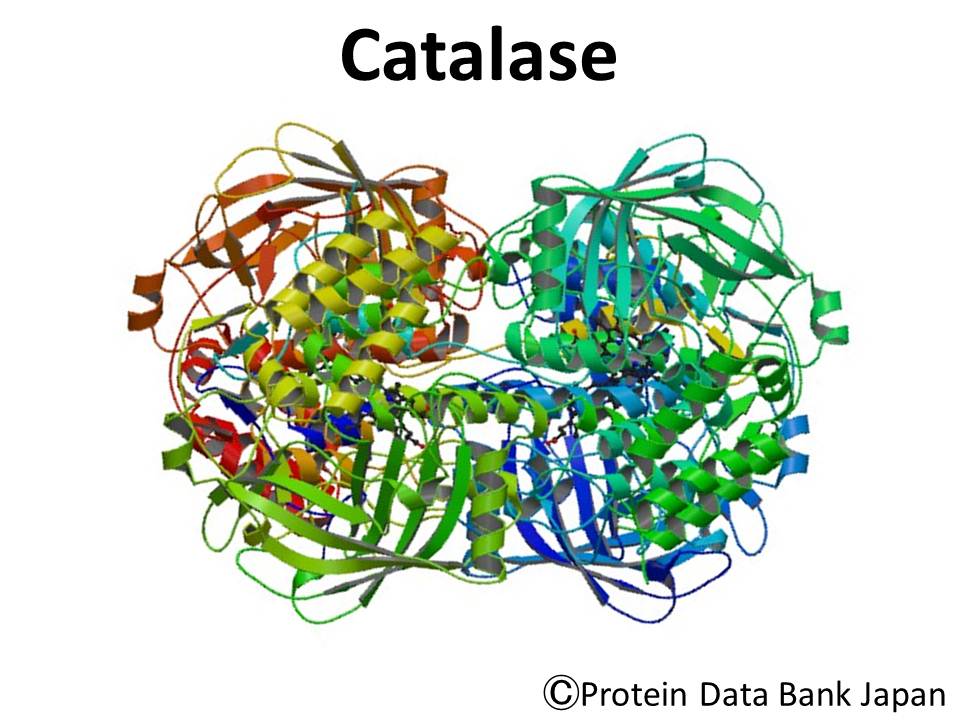
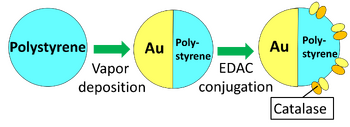
For speeding-up of Biomolecular Rocket, we experiment with another catalytic engine. Catalase is known as a enzyme that catalyzes the hydrogen peroxide solution. And we expect that this enzyme will be new catalytic engine of the Biomolecular Rocket because a enzyme activity of this enzyme is 100 000 times stronger than that of platinum. In this experiment, we deposit chromium for half surface of polystyrene beads and catalase conjugated onto polystyrene side. In addition, we observe a behavior of the beads in diluted H2O2 solution.


2.High-speed
- High-speed movement of Biomolecular Rocket
- Catalytic engine produced sufficient energy to move quickly, but further accelerate the Biomolecular Rocket, we conjugated numerous platinum catalytic engines to a rocket body by taking advantage of DNA hybridization and denaturation. Emission of the bubbles depends on the surface area of catalyst. If the catalytic surface area is expanded, it is obvious that our rocket will be able to emit more bubbles and speeding up.
- In this section, we introduce 1 method that involved in high-speed movement of biomolecular Rocket.
- <HTML><A href=#Analysis_of_platinum_by_High-speed_camera title="High-speed camera"><IMG width="190px" src="http://openwetware.org/images/6/60/High-speed_camera.jpg"></A></HTML>
Analysis of platinum by High-speed camera
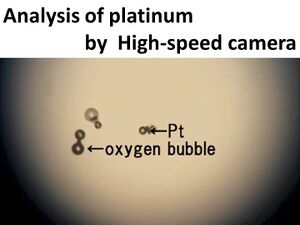
By using highspeed camera, we studied how the catalytic engine produce the driving force.In this study, we had 3 inference. Driving force is
- 1.produced in concurrence with the generation of bubbles
- 2.produced as the bubbles are destructed
- 3.produced as the bubbles detach
To research these problems, we analyzed when the moving speed of platinum beads and the acceleration of that would change.

3.Directional control
- Directional control of Biomolecular Rocket
- Direction of the rail-free movement of our rocket can be controlled, since we designed the photoresponsive DNA. Photoresponsive DNA structure is changed by UV light irradiation, then dissociation of double strand DNA will happen.
- In this section, we introduce 2 methods that involved in directional control of biomolecular Rocket.
- <HTML><A href=#Design_of_azobenzene-modified_DNA title="Design azobenzene-modified DNA"><IMG width="190px" src="http://openwetware.org/images/a/ac/Azobenzene_modified_DNA.jpg"></A></HTML><HTML><A href=#Dissociation_of_azobenzene-modified_DNA_by_UV-light_irradiation title="Dissociation of DNA"><IMG width="190px" src="http://openwetware.org/images/9/97/Dissociation_of_DNA.jpg"></A></HTML>
Design of azobenzene-modified DNA

Dissociation of azobenzene-modified DNA by UV-light irradiation
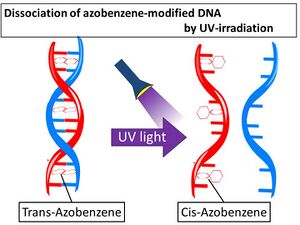
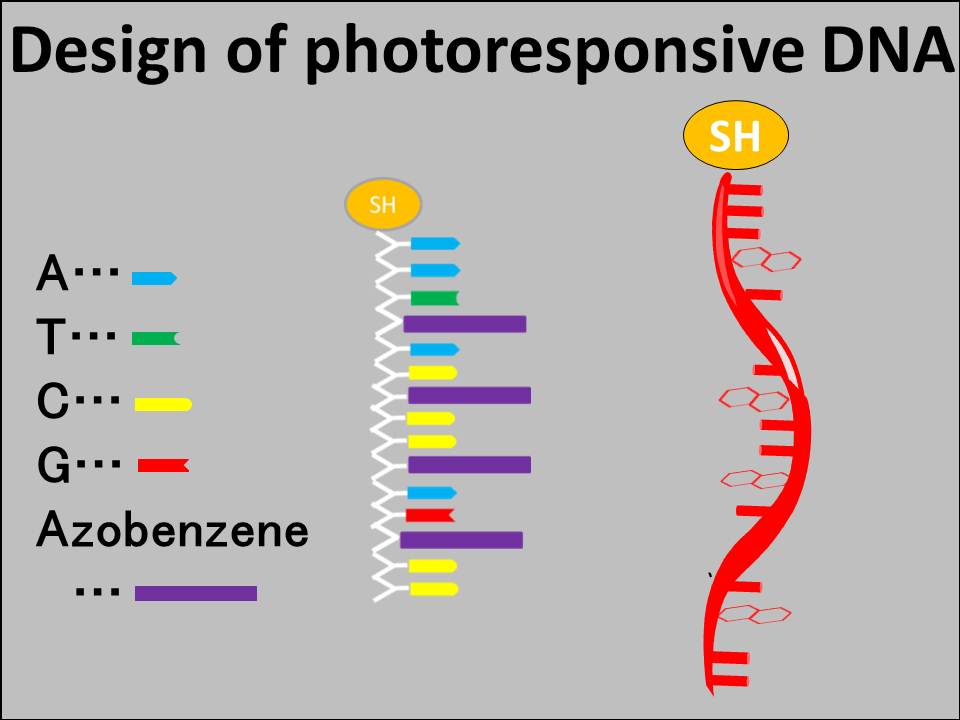
The duplex-forming activities of DNA can be photomodulated by incorporation of an azobenzene unit. The duplex is dissociated on isomerizing the trans-azobenzene to the cis form by irradiation with UV light. The duplex is formed again when the cis-azobenzene is converted to the transazobenzene by irradiation with visible light.
We inserted this function into a bead-body and add the photo-switching function to the body.In brief, so that we can detached the engines by irradiation with UV light, we attached a part of engines to the body with DNA duplex incorporating azobenzene unit.

DNA design
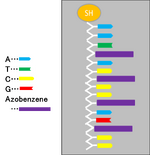
Image1 in detail
- 5’ -(HS)-AATxACxCCxAGxCC-3’ (x=azobenzene)
1.We incorporated 4 azobenzene units into 11 bases DNA so that we can quickly dissociated DNA duplex.
2.5’ end of this DNA was modified by a thiol group(HS-) for forming Au-thiol bond with Au covered bead body.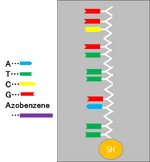
Image2 in detail
- 5’-(HS)-GGCTGGGTATT-3’
1.This 11 bases DNA are a complementary sequence of DNAⅰ(photoresponsive DNA).
2.5’ end of this DNA is modified by a thiol group(HS-) for forming Pt-thiol bond with Pt.


Ascertain the photo-switching system

- Spectrophotometer
- We measured DNA absorbance and ascertain the duplex-forming and duplex-dissociation activities of DNAⅰ and ⅱ. As the ordered regions of stacked base pairs in the DNA duplex are dissociated, the UV absorbance increases. This difference in absorbance between the duplex and single strand state is the result of nearest neighbor base pair interactions. In other words, when the DNA is in the duplex state, interactions between base pairs decrease the UV absorbance relative to single strands. When the DNA is in the single strand state the interactions are much weaker,due to the decreased proximity, and the UV absorbance is higher than the duplex state[image3].
>>see Result